News & Announcements
St. Luke’s teams eagerly lend their support at Ski World Cup Finals in Sun Valley

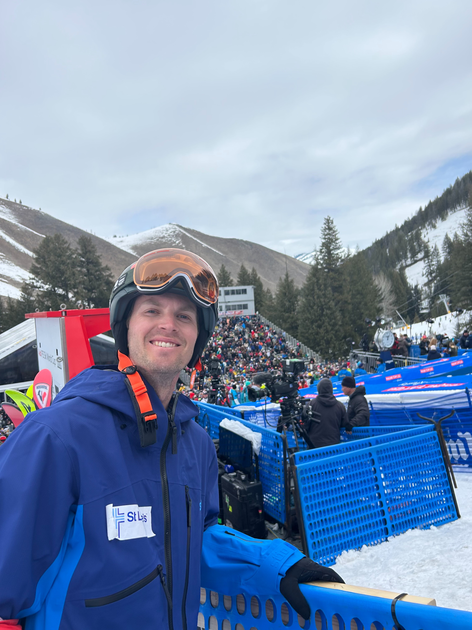
Drs. Kelly DiLorenzo, Deb Robertson, Mark Hopkins and Autumn Loomis representing St. Luke’s at the Audi FIS Ski World Cup Finals.
By Chris LangrillLast Updated April 11, 2025
In late March, the best skiers from around the globe converged on Sun Valley, and St. Luke’s was ready to help make it a world-class event.
Hosting the Audi FIS Ski World Cup Finals from March 22 to March 27 was a true community effort.
Volunteers and community members showed up in full force to manage the large crowds that descended on the area to watch the world’s top alpine ski racers compete.
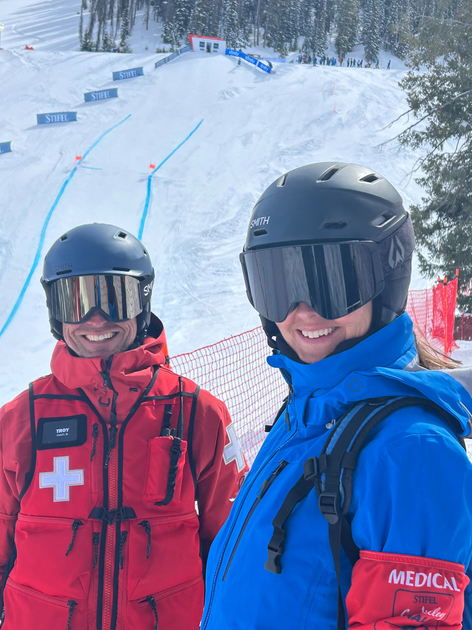
Dr. Autumn Loomis, right, emergency department physician at St. Luke’s Wood River and Sun Valley ski patrolman Troy.
“I think Sun Valley was very excited – and the racers were very excited – about the number of people that showed up,” said Dr. Deb Robertson, a physician who works in the St. Luke’s Wood River emergency department. “It’s a big ski community, so it’s not totally surprising. But people came in from all over the world for this event. It’s like the Super Bowl of skiing.”
Teams from around St. Luke’s Health System had a large role in staging the event.
Physicians, primarily from Boise, came to Sun Valley to help the local team’s efforts, as did nurses, techs and other staff members. Local personnel also put in extra hours.
“St. Luke’s helped out ER backfill, so we could have people on the mountain,” Robertson said. “I really appreciate how St. Luke’s supported us. I’ve worked at St. Luke’s for a long time, and they come through in so many different ways. … (we also had) Air St. Luke’s was at every race. So, they stepped up.”
Dr. Kelly DiLorenzo, another physician at St. Luke’s Wood River who is also the medical director for Sun Valley Ski Patrol, was integral in planning for medical care for racers on the mountain.
“There was a lot of preparation that went into the races,” DiLorenzo said. “We tried to go through every worst-case scenario … so it was pretty gratifying to see all that hard work pay off.”
St. Luke’s had multiple ER physicians on hand for each race and they were staggered throughout the courses on skis.
“It was pretty incredible,” Dr. DiLorenzo said. “We had physicians from Boise and Montana (among other places) come and help us out. They were eager to help out at a World Cup, which was pretty cool.”
And thankfully, despite the necessary preparation, the scenarios never came to be, as there were no major injuries during the races.
“I’ve been following World Cup races throughout the season, and there were quite a few bad crashes that happened at other races,” Dr. DiLorenzo said. “We were prepared to take care of what could have been potentially serious injuries.”
Part of that preparation was having the presence of Air St. Luke’s at the races.
Jeff Safley, critical care supervisor for Air St. Luke’s, said his team wanted to keep its regular operations intact while also providing service at the World Cup Finals.
“The biggest thing for us was having a third helicopter,” Safley said. “We were committed to not reducing our two-helicopter community response availability. So, we had a … backup helicopter, and working in conjunction with Idaho Helicopters – they were incredibly supportive – it allowed us to provide that third helicopter.”