Patient Stories
St. Luke’s team collaborates to make baby’s early delivery, surgery successful in rare case

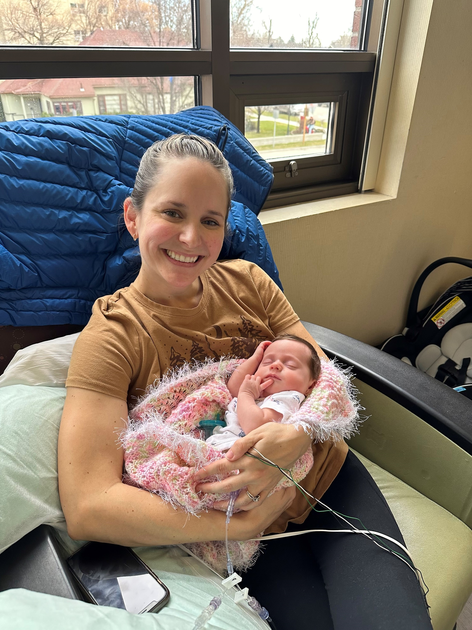
Natalie and Dustin Fuller see their daughter, Ariya, through an isolette at the St. Luke’s Boise NICU.
By Dave SouthornLast Updated March 8, 2024
What follows is a story of incredible teamwork, expertise and strength, but it all started with something powerful yet perhaps a little less measurable — a mother’s intuition.
In December 2023, an expecting Natalie Fuller of Meridian noticed her baby, not due for about eight more weeks, wasn’t moving as much as usual.
“I was just getting over having COVID, but it just didn’t feel right since she was normally active,” Fuller said. “I didn’t sleep very well because it was all I could think about.”
The morning of Dec. 21, she talked with her husband, Dustin. He agreed Natalie should reach out to her longtime obstetrician, Dr. Brea Shrum.
Natalie sent a message via MyChart, kicking off a day her family and multiple St. Luke’s teams won’t soon forget. Twelve hours later, it resulted in the birth of daughter Ariya Fuller, but in a way, that was just the beginning.
“I think it very much was a case of everyone playing their part on the team, starting with Natalie,” Dr. Shrum said.
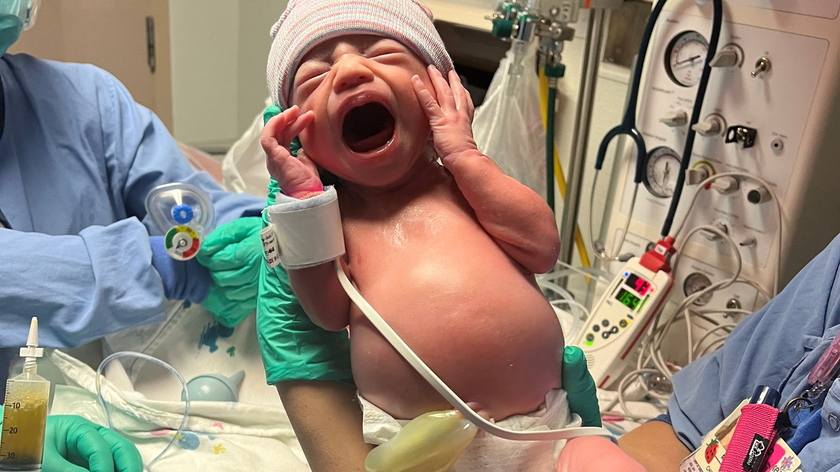
Ariya Fuller, soon after being delivered via C-section, but prior to her surgery. Her distended belly was immediately clear.
Added maternal fetal medicine specialist Dr. Duncan Harmon: “What happened was no small feat, and the outcome may not have been a good one if they hadn’t contacted us. It’s easy to think, ‘We can just wait,’ so those parents need to be applauded to get this whole thing started.”
Within 10 minutes of sending that message, Natalie had a response from Shrum’s office to come to St. Luke’s Boise for monitoring. The Fullers had their 2-year-old son, Sawyer, at day care, so they had no problem coming in for what they assumed was a regular visit.
“I told my boss I’d be gone only a few hours,” Fuller said with a laugh.
Dustin said the first 30 seconds when the fetal heartrate monitor was being placed were the longest of his life, waiting to see if there was any reason to worry. Shrum said nothing looked immediately abnormal, but the results weren’t ideal — “not concerning, but not reassuring.”
She called Harmon to perform an ultrasound to get a better look.
Harmon fairly quickly noticed Ariya had a dilated bowel. Initially, he thought it may be an atresia, or a blockage. He contacted St. Luke’s Children’s pediatric surgeon Dr. David Klima about what he was seeing. Klima asked if volvulus had been ruled out.
“If it’s atresia, you usually can wait and deliver at term, then address it,” Harmon said. “Volvulus is acute twisting on its own blood supply. That segment dies and it really increases the risk of stillbirth.
“If the diagnosis is wrong, you add risks delivering early when you perhaps did not need to.”
By this time, it was approximately 4:30 p.m., about six hours after that MyChart message was sent.
“When the ultrasound tech, two nurses and Dr. Harmon came in, that’s when the full weight of the situation hit,” Fuller said. “I got lightheaded, put a cold towel on my neck. I heard ‘stillbirth,’ and I knew it wouldn’t be regular checkup.
“But Dr. Shrum tells us how it is, that’s what I like. She said, ‘Drs. Klima and Harmon, they have their jobs for a reason,’ and they’d figure it out. We were ready to do whatever they suggested.”