Patient Stories
Coordination of care in baby’s surgery leads to ‘great patient experience’ for McCall family
By Laura CrawfordLast Updated January 30, 2024
Amanda and Steve Keaveny of McCall were in that “magical post-partum phase” after the birth of their third son Eddy. The family was settling in, and Eddy was eating, sleeping and healthy.
All of the Keaveny boys were delivered at St. Luke’s McCall. Eddy was the first to be delivered in one of the birthing rooms at the new hospital, which opened in July.
“It was a peaceful experience,” Amanda said. “The nurses knew all the techniques and strategies of supporting a natural birth. They knew what I wanted before I knew.”

Eddy Keaveny getting some love from his two older brothers.
After returning home, everything was going as the Keaveny family expected. Until around when Eddy was five weeks old, he began to spit up more than usual. Amanda thought it could be acid reflux or maybe she was overfeeding him.
But things changed quickly from being normal to “not being right,” she said.
Eddy transitioned from spitting up to projectile vomiting. Another warning was Eddy’s light diapers.
Amanda’s mom — Eddy’s grandmother — was visiting the family at the time. She shared that Eddy’s symptoms sounded familiar to a condition Amanda’s father had when he was an infant.
The condition, hypertrophic pyloric stenosis, is a narrowing of the pylorus, a muscular valve at the bottom of the stomach — often called the “olive” due to its size when normal. When it becomes too thick, or hypertrophied, breastmilk or formula can’t get through to the small intestines. This can lead to excessive vomiting, according to the American Academy of Pediatrics.
While HPS is considered rare, it is more common in male infants and sometimes runs in families.
It was a Friday in early October, and Eddy’s symptoms continued to worsen.
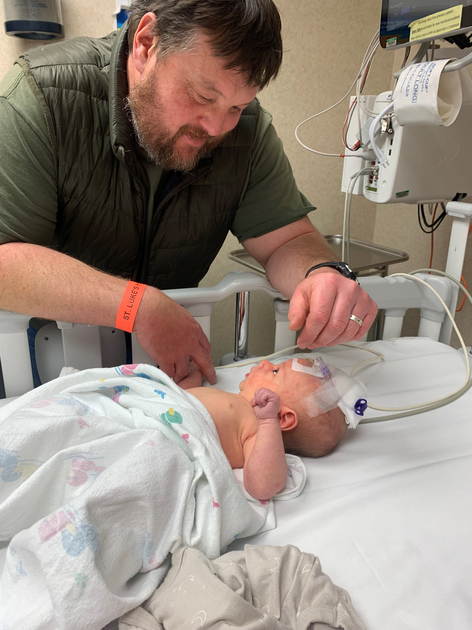
After a trip to the St. Luke’s McCall Emergency Department, an ultrasound was recommended to help diagnose HPS, as it provides a picture of the pylorus, which would present thicker and longer than normal if HPS is the issue.
The earliest the exam could be done was the following Monday, as St. Luke’s McCall is unable to offer 24/7 ultrasound services. Nurse Liz Watson connected with St. Luke’s physician Dr. Paddy Kinney, who, after examining Eddy, said there was no reason to wait until Monday to get an ultrasound in McCall and referred them to Boise.
“Dr. Kinney was confident and decisive on what we needed to do,” Amanda said.